Too Much of a Good Thing: Scope and the Future of Apps
Now that we can do anything, why are we trying to do everything?

A few years ago, Lickability alumnus Sam Henri Gold made a strong case for why your app doesn‘t need a chat feature. So much has changed in this short time; in the ensuing years, most tech sectors have seen huge financial swings, layoffs, and product development shifts (often with limited success), thanks largely to advancements and ballooning investments in AI. Public perception of AI still skews negative-neutral, but this hasn’t stopped many from feeling empowered to build due in part to AI putting no-barrier tools into the hands of talented, but less-technical, people. (See: Lovable, Claude Code, bolt.diy, etc.)
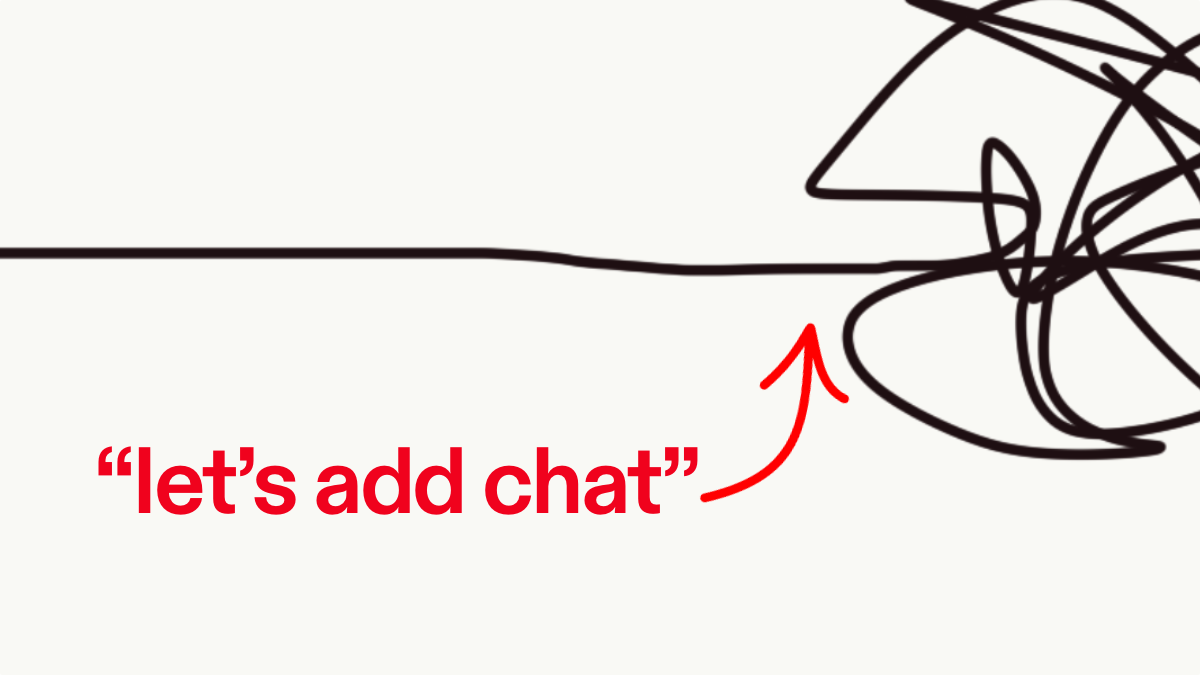
But even with this newfound promise that anyone can build anything, success is never guaranteed. What if you want to spin up an idea into a product you can sell to others? It’s easier now than ever, but also easier to stumble into the same — and more — pitfalls of unnecessary features.
This got us thinking: what do people even want out of apps in the frenetic landscape of 2026? What are product developers, designers, or even our prospective clients eager about adding to apps and software? Is everything becoming same-y “slop,” or is that an easy hand-wave?
Incessant Features and Scope
To learn what some of our prospective clients’ pitches have had in common, and how much they are (or aren’t) in touch with what the average user wants out of their app experience, we turned to our frontline team.
With AI being so massively popular, everyone wants to tout some kind of integration with the hopes of riding this wave. But while these tools are nearly ubiquitous now, the minutiae involved in their adoption and integration still isn’t fully understood by the average person.
I am seeing a lot of requests to “integrate AI chatbots” in the pitches we get, but people are not thinking any further on what model to use, how they intend to prompt it and the subsequent necessary pipelines, or even evaluating the drastically-differing costs to use said models. It’s fine to want to capitalize on new technologies, but people often aren’t considering what their end goals are when adding these features to their products.
– Tom (Sr. Account Manager)
Keeping scope in check continues to prove an issue for many. As mentioned before: AI has proven useful for technical and non-technical professionals to iterate and ideate very quickly, but can often lead to putting the cart before the horse and not knowing just how insecure, expensive, or deceptively-complicated proper integration will end up being.
Anything that brings in user-generated content. A great example is profile pictures / avatars. Clients want this but don’t know that this seemingly “easy feature” also necessitates bringing in moderation tools (manual or automatic) to secure against illegal or harmful content. This is an easy way to balloon scope but can sometimes be creatively worked around (e.g. user avatars as initials, pick from a pre-defined list of images, emoji etc.)
– Tom
Creative workarounds for curbing scope creep
A great example of giving users a sense of personal identity without needing to allocate time and money on content moderation is Transit‘s approach: randomly-assigned combinations of adjective-emoji usernames with a matching avatar.

This is, however, also an example of creativity thriving on restrictions, as it was once possible to pick your own custom username, with Transit removing the option in 2024 due to some users choosing hateful names and ruining the fun for everyone.

Building for Users
Even if you keep scope in check and set out to create an app with the intention of solving one problem, what doesn’t it need?
‘We’re going to need a chat feature, and a micro-social network, and a feed for people you follow...’ In your gardening app? People just want apps to solve problems or make things more convenient for them, especially lately. There’s already a proliferation of options for social media, not to mention the content moderation nightmare running your own could create. It may seem boring, but limiting your features and focusing on doing one smaller thing extremely well goes a long way for people.
– mb (Partner)
Realizing this problem with feature creep, we spoke with our internal operations expert for examples of software features devs and designers swear she’ll use, but she finds herself not using:
AI meeting notes are a big one for me, and it feels like they’re in everything now. I recognize that it can be helpful to have an extra backup since it can be hard to quickly take accurate notes while talking in a meeting, but I have never found it truly useful to me, and far from a complete replacement. I much prefer taking my own notes during meetings — it helps me stay focused, I have the context that an AI tool doesn‘t to determine what is important and what isn’t, and it’s often more valuable to pause and ask someone to repeat or clarify something they said than it is to look at notes that I didn’t write and realize I don’t understand something.
– Jillian (Project Manager)
Does every app have to be an everything app?
I feel like so many apps try to be everything and it tires me out. I’d rather have one really good calendar app than an app that has a calendar, a to-do list, a habit tracker, a focus timer, and an AI chatbot to coach you through it all. Just pick one thing and do it well.
– Jillian
Software like Obsidian operates on a philosophy of “closed-core, open-source plugins.” At its core, Obsidian is very sparse, and its in-house development is focused on providing users with a program that’s efficient, secure, and available on a number of platforms. Is there a feature you want but don’t see? Build it in yourself, or choose from a huge library of options. Someone might have already solved your problem for you! It has the ability to be everything for some people, and only just enough for others, but enables users to have granular controls over their experiences.
Things is just a solid, beautiful-looking to-do app I’ve been using for years. It does exactly what it says on the tin, and it has never failed me. Unlike a lot of other apps in that space, the closest it gets to co-mingling with other products is integrating with your calendar so you can see a list of your calendar events while looking at your to-do list for the day, which is all I need. And even then, it doesn’t show up where it isn’t welcome.
I also really like what the folks at !Boring do. They have a whole suite of apps in their style that each do one specific thing: a weather app, a calculator app, a timer app, etc.
– Jillian
Looking to the Future
The broad takeaway, from our perspective, is while it’s easy to fall into the trap of chasing trends or wanting your app to be everything at once, the best products with the most longevity are proven to be the ones with thoughtful, intentional scope.